
Hotel shift handovers with AI: how to stop information loss between teams
Hotel information rarely disappears in one dramatic failure. It gets lost between shifts, departments and channels. Here is how AI can structure a handover, route it correctly and keep it searchable.
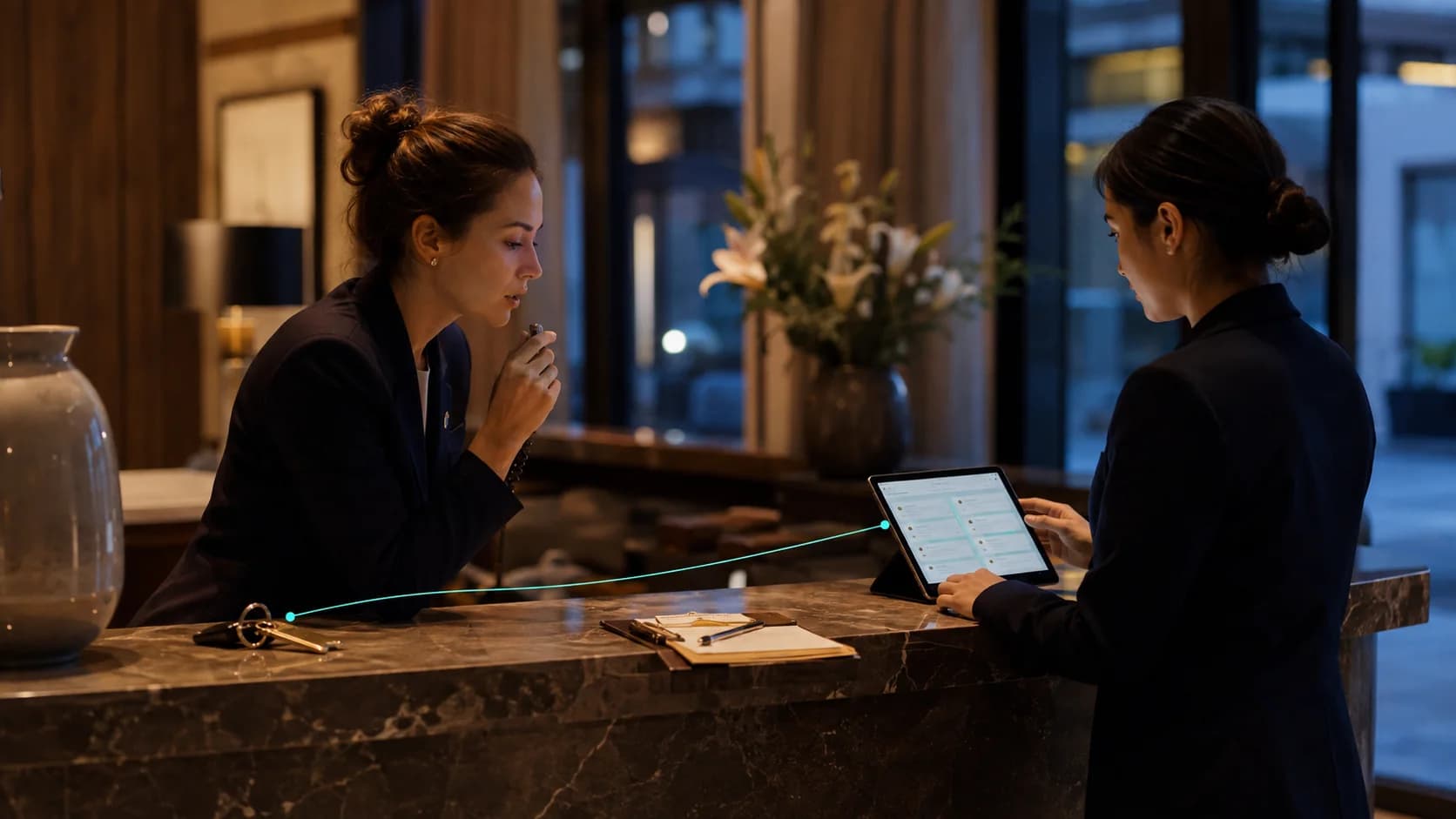
A guest mentions a problem at breakfast, reception writes it on a note, and maintenance never hears about it before the evening shift. Information loss in hotels is usually a chain of small handover gaps, not one large mistake.
AI helps when it sits inside the information flow instead of beside it as another chatbot. It can structure natural language, identify responsibility and make the result searchable later.
What does information loss mean in hotel operations?
Information loss occurs when a known fact fails to reach the person who needs to act. The result is repeated work, missed guest requests, unresolved defects and a fresh round of questions after every shift change.
Where does hotel information get lost?
Most gaps happen during transfer rather than capture. These seven points are especially vulnerable.
- 1
Late shift to night audit
An open guest request is mentioned verbally but never handed over as an action.
- 2
Reception to maintenance
A defect sits in the front-desk log until somebody follows up by phone.
- 3
Housekeeping to management
Repeated observations arrive separately and never become a visible pattern.
- 4
Messaging app to operations
One important message disappears between rota questions, replies and social chat.
- 5
Paper log to history
The entry exists but cannot be found three weeks later.
- 6
Between two languages
A literal translation loses the operational meaning of a short note.
- 7
From knowledge to ownership
Everyone knows about the issue, but nobody is visibly responsible.
Why do group chats and paper handover books fall short?
A group chat is fast but has no departments, status or reliable operational search. A paper log is calmer but stays in one physical place and cannot route work to the right team.
Both channels store messages. A hotel needs a process that turns each message into assigned information or action.
How can AI improve a hotel shift handover?
AI is useful where people speak naturally but the operation needs structure. It can split one handover into separate items, propose urgency and category, and identify the relevant department.
- 1
Speech becomes structure
Staff speak as they normally would, while the system turns the input into individual operational items.
- 2
Responsibility is proposed
A room defect, guest request and sensitive staff matter do not go to the same audience.
- 3
Urgent items remain visible
An immediate fault is treated differently from information for next week.
- 4
The history stays searchable
Teams search by room, topic, date or department instead of scrolling through old conversations.
- 5
Managers get a useful summary
The GM sees what matters without reading every individual message.
What should AI never decide on its own?
AI should not create false certainty. In avvicenda, Avvi proposes structure and routing; whoever hands over sees the proposal next to their own words and can correct it.
How does avvicenda prevent information loss?
avvicenda connects shift handovers, a role-based feed, task status, search and hotel knowledge in one browser tool. Staff can type or dictate.
- Every item receives a department, category, priority and status.
- Staff see what is relevant to their role rather than the whole hotel stream.
- Urgent matters stay visible until they are accepted or completed.
- The history is searchable and changes remain traceable.
- Avvi answers questions from approved hotel knowledge and checklists.
- Daily and weekly views give the GM a filtered picture of the operation.
The 5 steps to reduce hotel information loss
- 1
Choose one handover source
Do not run parallel truths in paper, chat and spreadsheets.
- 2
Set three mandatory questions
What happened, who does it affect, and what happens next?
- 3
Assign each item to a department
A message for everybody is often owned by nobody.
- 4
Keep status until completion
The next shift must see whether an item is open, being handled or done.
- 5
Count follow-up questions after one week
Fewer calls and fewer “who owns this?” moments are an honest first success measure.
Frequently asked questions about AI shift handovers
Can AI write a hotel shift handover?
AI can structure spoken or written notes into a handover draft. A team member should confirm the draft before it is published.
Does AI replace the face-to-face handover?
No. It preserves and distributes the facts so that a conversation is not the hotel’s only memory.
How does AI avoid sending an item to the wrong department?
It works with the departments enabled by that hotel and shows the proposal before saving.
Is an AI handover useful for a small hotel?
Yes, once several shifts or departments share operational information. Small teams often benefit most because they have no separate coordination office.
Where does avvicenda process hotel data?
Avvi runs on Claude via AWS Bedrock in EU data centres. Each rollout still needs clear contracts, access roles and deletion rules.
Done with sticky notes.
Take a look at avvicenda™: 30-day free trial, no credit card.