
The digital hotel handover book: paper, spreadsheet or app? The complete guide (2026)
In most hotels the handover book at reception is still a paper pad or a spreadsheet on a shared drive. Where both run out of road, what a digital logbook has to do, and how to tell a good one from a bad one.
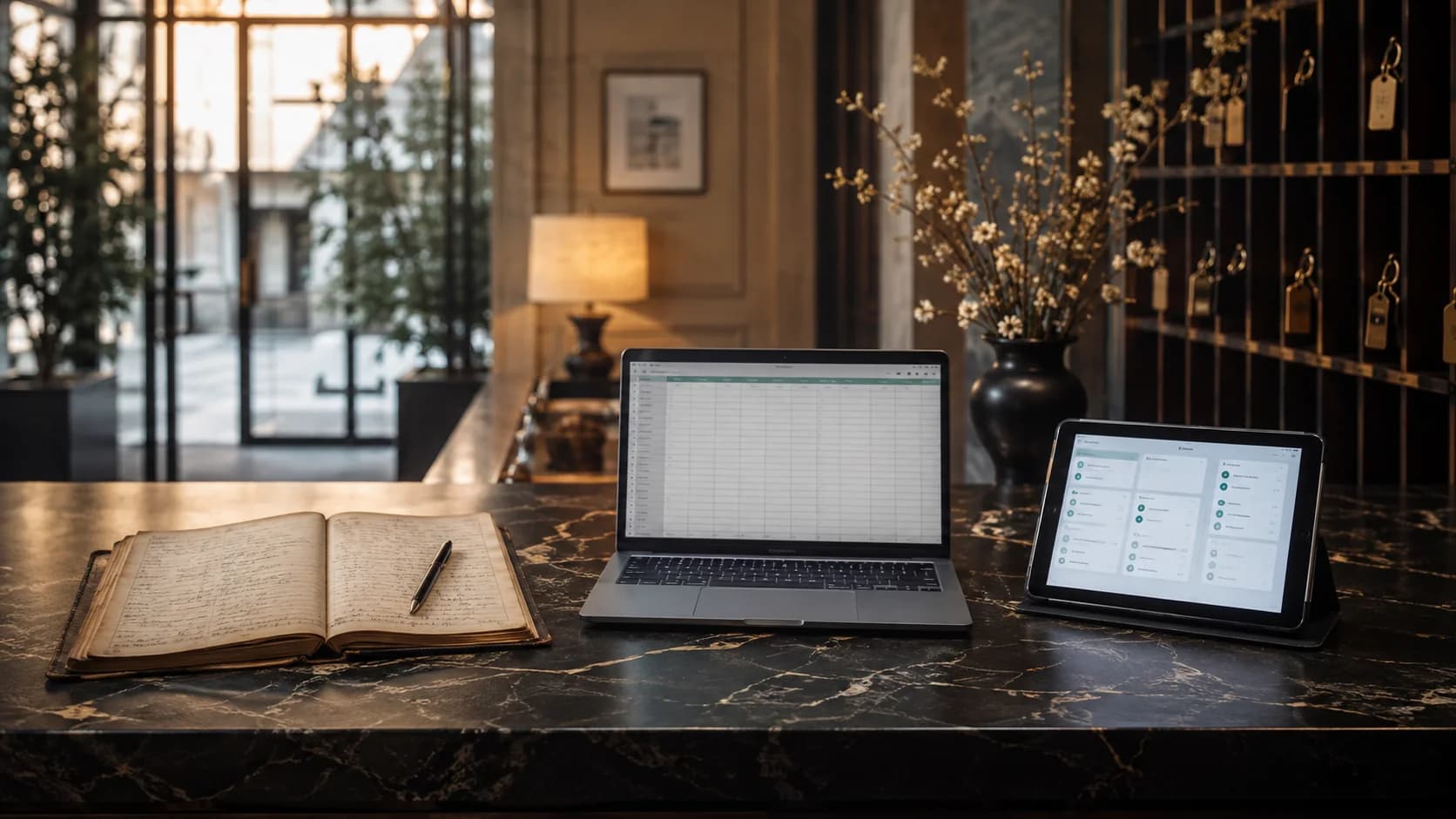
Almost every hotel keeps a handover book. In most properties it is a pad at the front desk or a spreadsheet on a shared drive. Both work — until they do not. This guide covers where the limits sit, what a digital logbook actually has to do, and how to choose between the options.
What is a hotel handover book?
The handover book is where one shift writes down what the next one needs to know: open tasks, notable guests, faults, incidents. It is the property’s memory between two shifts.
The words get mixed up — handover book, shift log, logbook, or just "the book" at reception — but they all mean the same thing. What matters is not the name but whether the next shift can find what concerns them in two minutes.
Why does the paper handover book fail?
Paper does not fail at writing, it fails at finding. Anything noted three weeks ago is effectively gone, because nobody flips through 60 pages.
Three problems show up in every property still working with a pad:
- 1
It cannot be searched
Nobody answers "when was that heating thing in 212 again?" from the book. Somebody guesses instead, and the answer is roughly right.
- 2
It cannot always be read
Handwriting at the end of a night shift is its own discipline. What cannot be deciphered gets asked about — or ignored.
- 3
It exists in exactly one place
The book sits at reception. Housekeeping, maintenance and anyone away from the property have no access. The manager who most needs the overview sees the least of it.
Then there is the evidence problem. If somebody later asks whether a complaint was handled or when a fault was reported, a paper pad is a poor record. Entries can be changed afterwards, and nobody can see who wrote what and when.
Is a spreadsheet a good middle step?
A spreadsheet beats paper and loses to a proper tool. It fixes legibility and partly fixes search, but it brings new problems the moment more than two people use it.
- Two people in the same file at once: either it locks, or you end up with copies called "handover_final_v2_NEW".
- No roles: either everyone sees everything, HR matters included, or you split it into files nobody merges again.
- No status: whether an item is done lives in a column somebody has to maintain by hand.
- No phone access: in practice that means nothing gets entered on the move and the sticky note comes back.
- No history: who changed what, and when, cannot be reconstructed later.
For a property with one department and two people per shift, a spreadsheet can be enough. Once reception, housekeeping and maintenance are all involved, the file becomes the bottleneck.
What does a digital handover book have to do?
A digital logbook is more than a text box in a browser. The list below is the short version of what actually counts in daily hotel operations.
- 1
Fast to fill in
If capturing takes longer than the old book, it will not get used. Under two minutes per handover is the line where a team comes along.
- 2
Route by role
Housekeeping needs different items than maintenance. A system that blasts everyone with everything gets skimmed exactly like the WhatsApp group.
- 3
A status per item
Open, in progress, done. Without status, "is anyone on this?" becomes a daily question.
- 4
Make urgent look urgent
The fault in 204 must not sit visually next to the minibar note.
- 5
Searchable history
The value does not appear on the day of writing. It appears three weeks later, when somebody looks it up instead of asking.
- 6
Works on a phone
Housekeeping does not sit at a desk. If it does not run in a mobile browser, the sticky note returns.
- 7
Handles more than one language
In many properties the team’s first language is not the property’s. A book that speaks one language loses exactly the people who see the most.
- 8
Leaves a trail
Who entered what, and when? Without that trail, a digital book is no better than paper for evidence questions.
What are the legal points to keep in mind?
No regulation requires a hotel to keep a handover book. It becomes relevant where it serves as evidence — and where it holds personal data.
Three points you can keep an eye on without a lawyer:
- Evidence value: if an entry is meant to show later that maintenance happened or a complaint was handled, it needs a timestamp and an author. A document that can be overwritten afterwards is weak proof.
- Guest and staff data: as soon as names, room numbers or sick notes go in the book, GDPR applies. Any digital tool then needs a data processing agreement, a look at where the servers are, and a deletion rule.
- Private devices: a handover book living in a WhatsApp group means hotel data sits on private phones the property does not control. That is the point where many hotels switch.
This section is practical orientation from a hotelier’s point of view, not legal advice. For binding questions, put a lawyer at the table.
Which options are on the table?
The field runs from a free stopgap to an enterprise platform. These four routes are the ones you actually see.
- 1
avvicenda™ — the handover book as its own tool
First because it solves this one problem instead of selling a whole platform: speak or type the handover, categorised automatically and routed to the right department. Browser-based, four languages, from €179/month. Full disclosure: avvicenda is our product.
- 2
hotelkit — the broad team platform
Covers communication, housekeeping and facility management and is strong with groups and chains. For a 40-room property without IT, the scope is usually more than the operation needs.
- 3
Excel or Google Sheets
Free and available right now. Carries a small team for a while, but does not scale across departments.
- 4
Industrial shift-log tools
Search for "digital handover book" and you mostly find tools built for factories. They handle shift logs well but know nothing about rooms, arrivals or housekeeping.
How do I know the switch worked?
Not because a system went live, but because the follow-up questions stop. The first morning nobody asks "so what happened last night?" is the proof.
- The next shift reads instead of asking.
- Leadership knows what is going on without being on site.
- New colleagues look things up instead of interrupting somebody every day.
- After three weeks somebody finds an old entry again — that is the moment the book starts paying for itself.
Frequently asked questions
What does a digital handover book cost?
Tools aimed at small and mid-sized hotels start at around €200 per month for the whole property. Platforms built for groups and chains usually quote on request only.
Is a WhatsApp group enough as a handover book?
For two or three people it works as a stopgap. Once several departments and shifts are involved it lacks structure, roles and search — and hotel data ends up on private phones.
How long does moving from paper to digital take?
Technically a browser-based tool is set up in a day. The real work is the first week, while the team changes its routine.
Does every team member need their own login?
Yes, otherwise neither roles nor traceability work. A shared login makes every entry anonymous and worthless as evidence.
What happens to the old paper book?
It stays on the shelf as long as your retention rules require, but nobody writes in it any more. Running two systems in parallel is the surest way to end up maintaining neither.
Done with sticky notes.
Take a look at avvicenda™: 30-day free trial, no credit card.