
Banquet event order (BEO): what it includes, an example and a free template
The BEO decides whether an event runs smoothly or whether someone in the kitchen asks at 12:25 pm how many vegetarians there actually are. Here you will find what belongs in it, what a completed sheet looks like and where things go wrong in practice. The template is available as Word and PDF, with no sign-up.
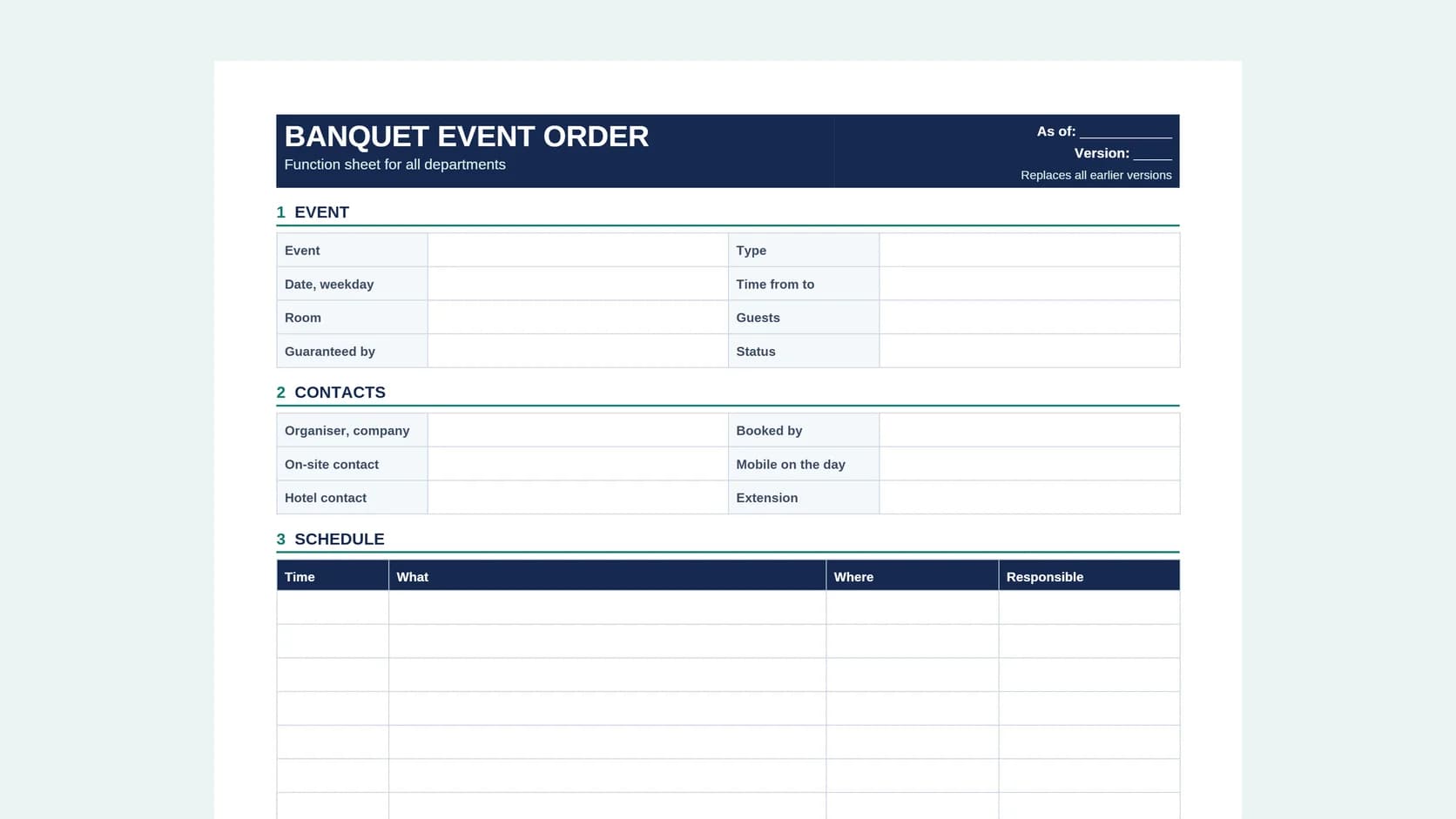
What is a banquet event order?
A banquet event order (BEO) is the working document for an event in a hotel. On one or two pages it tells kitchen, service, AV, front desk and housekeeping what they need to know: who is coming, when, in which room, what will be eaten and drunk, and who pays.
A banquet event order, BEO for short, is also called a function sheet or event order. In German-speaking hotels the usual word is function sheet. They all mean the same document.
BEO or banquet brochure: what is the difference?
The banquet brochure is aimed at the guest. It shows rooms, packages and menus and helps with selling. The BEO is aimed at the team and is only written once an event is booked. The brochure sells, the BEO delivers.
What belongs in a banquet event order?
Twelve sections have proved their worth. The template is built exactly this way.
- 1
Event.
Name, type, date with weekday, time, room, number of guests and the date by which the number is guaranteed.
- 2
Contacts.
Organiser, the person who booked and above all: who makes decisions on site on the day itself, with a mobile number. Plus the hotel contact.
- 3
Schedule.
Each line with the time, what happens, where and who is responsible.
- 4
Room and seating.
Seating style, tables, when the set-up must be ready and from when breakdown may start.
- 5
AV and equipment.
Tick boxes instead of writing. Plus when the AV check takes place and what the guest brings along.
- 6
Food.
One line per occasion with the time. Vegetarian, vegan and allergies with numbers and, if possible, with names.
- 7
Beverages.
What is served where, and how it is billed: flat rate or on consumption. Who may approve extras?
- 8
Front desk and housekeeping.
Room block, arrival and departure, parking, cloakroom.
- 9
Billing.
Billing address, what the organiser pays for and what guests pay themselves.
- 10
Special notes.
VIPs, surprises, speeches, anything that does not fit into a field.
- 11
Changes since the last version.
What has changed since the last version, by whom, and who it affects.
- 12
Distribution and approval.
Which departments have the sheet, and who approved it.
A completed example
Sales meeting, 24 guests, one day. This is what the fields look like where things tend to go wrong in practice:
| Field | Entry in the example | Why |
|---|---|---|
| Guests | 24 (expected 22 to 26), guaranteed by 9 Nov 2026, 12 noon | Kitchen and service plan with a range, billing starts from the guaranteed number. |
| Allergies | 1 × nuts (Mr Aydin), 1 × gluten-free (Ms Sommer) | With names, service finds the right plate for the right guest. |
| Beverages | In the room flat rate, with meals on consumption | Prevents a discussion when the bill comes. |
| Paid by the organiser | Day delegate rate, rooms, beverages with meals | At check-out the front desk knows what is charged to the room. |
| Changes | 4 Nov: Guests 20 → 24, seating classroom → U-shape | Anyone who knows version two sees at once what is new. |
The complete sheet is available as a PDF to download above.
The five most common mistakes
- 1
No version number.
Two sheets with the same name, and nobody knows which one applies. Fix: date and time of the version in the header, collect the old versions.
- 2
Changes are somewhere in the text.
Nobody rereads two pages to find a changed main course. Fix: a separate section, old → new.
- 3
Allergies without numbers.
“Please note allergies” does not help the kitchen. Fix: number, type, name.
- 4
The on-site contact is missing.
The person who booked sits in an office in another city. Fix: the mobile number of the person who is actually in the room.
- 5
Billing not settled.
Whether the bar the evening before goes on the company’s bill is then sorted out in the morning at the front desk, in front of the guest. Fix: fill in section 9 before the sheet goes out.
When should the BEO be final?
Two versions are usual. The first goes out as soon as the event is confirmed, so that the rota and purchasing can plan. The final version follows once the number of guests is guaranteed, usually three to five working days before. In many hotels it is discussed in a weekly meeting with all departments.
Where Word and paper reach their limits
The template is enough for a hotel with a few events a month. It gets difficult when a lot changes. Every change means: open the file, edit it, distribute it again, collect the old sheets. And every department gets everything, including prices that not everyone needs to see.
A digital BEO solves exactly these two points. Each department sees its own section, and the top shows what is different since the last look. This is how the Banquets and meetings module from avvicenda works.
Frequently asked questions
What does BEO stand for?
BEO stands for banquet event order. Some hotels say function sheet or event order instead.
Is a BEO the same as a function sheet?
Yes. Banquet event order is the term from international chain hotels, function sheet is more common in German-speaking countries.
Who writes the BEO?
The person who sold the event or looks after it, so the banquet office, sales or, in smaller hotels, the front desk or management.
How long should a BEO be?
Short enough to be read. Two pages are enough for a meeting. A wedding with a programme needs more, and then the schedule belongs on a separate sheet.
Do I need a separate sheet for each department?
On paper it is rarely worth it, because you then maintain several versions. Digitally it is the norm: one source, one view per department.
Done with sticky notes.
Take a look at avvicenda™: 30-day free trial, no credit card.